
The signs you or your child may need an orthodontist include crowded or crooked teeth, noticeable gaps, an overbite or underbite, jaw soreness, clicking when chewing, and teeth that don’t meet properly when you bite down. Difficulty chewing, early or late loss of baby teeth, and mouth breathing also warrant an evaluation.
An orthodontic specialist looks at more than how a smile photographs. We study how your upper and lower teeth fit together, how your jaws grow, and how your bite handles daily chewing and speaking. That’s why two people with similarly straight-looking teeth can need very different care.
Most families notice the first clues at home. You might see a permanent tooth erupting behind another, a front tooth that sticks out, or a child who rests with their mouth open. Other signs stay hidden until someone measures the bite, including crossbites, midline shifts, and crowding that hasn’t shown up yet because the permanent teeth haven’t arrived.
No referral from your dentist is needed to be seen. Anyone can schedule a free consult and get a straight answer about whether treatment is needed now, later, or not at all.
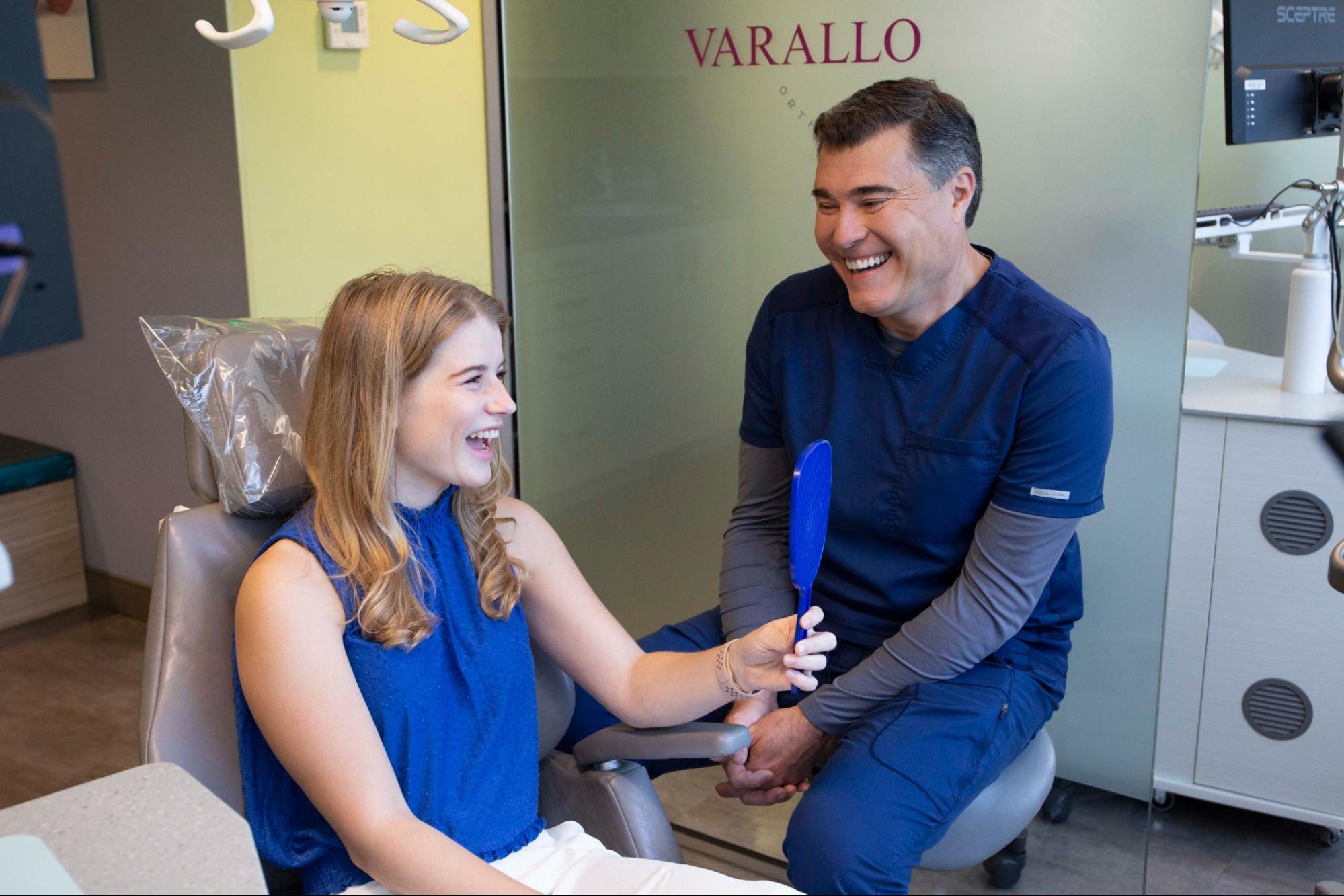
The Most Common Signs You or Your Child May Need an Orthodontist, by Age Group
Warning signs change with age. Children ages 6 to 10 often show crowding, early or late loss of baby teeth, or a thumb habit. Teens tend to show protruding front teeth, a deep overbite, or a crossbite. Adults notice shifting teeth, worn enamel, and gum recession. Jaw sounds and mouth breathing matter at every age.
What Signs Appear in Children Ages 6 to 10?
- Baby teeth that fall out much earlier or much later than their siblings’ did
- Permanent teeth erupting out of place, twisted, or behind the baby teeth
- Crowding that leaves no room for incoming teeth
- Thumb or finger sucking that continues past age 4
- A jaw that shifts to one side when they close their mouth
- Trouble biting into food like apples or sandwiches
According to the American Association of Orthodontists, children should have a first orthodontic check-up by age 7. Enough permanent teeth have usually come in by then for Dr. Varallo to spot developing bite issues while the jaws are still growing.
What Signs Show Up in Teens?
- Front teeth that protrude noticeably past the lower teeth
- A deep overbite where the upper teeth cover most of the lower teeth
- A crossbite, where one or more upper teeth sit inside the lower teeth
- Back teeth that never quite meet, making chewing feel uneven
- Crowding or spacing that got worse after the last permanent teeth erupted
- Chipped edges on front teeth from teeth striking each other
What Signs Do Adults Notice?
Teeth keep moving throughout life, and adults usually register the change before anyone else does. A lower front tooth that sat flat for years starts to overlap its neighbor, or a retainer from high school stops seating the way it once did. Many adults come in because something changed.
- Lower front teeth that have crowded or overlapped over the years
- Worn, flattened enamel on the chewing surfaces
- Gum recession around teeth that carry too much bite force
- Relapse after braces years ago, often because retainer wear stopped
- Gaps left behind by a missing tooth, with neighboring teeth drifting
What Functional Red Flags Matter at Any Age?
Some signs have little to do with appearance. Bring these up at your first consultation:
- Chronic mouth breathing, snoring, or restless sleep
- Speech changes, especially with s, z, th, and sh sounds
- Jaw clicking, popping, locking, or morning tightness
- Biting your cheeks or tongue repeatedly
- Facial asymmetry, a receding chin, or a jaw that looks set forward, which can signal a growth discrepancy between the upper and lower jaw
Why Acting Early on These Signs Matters
Timing changes what treatment can accomplish. While a child’s bones are still developing, we can guide jaw growth and create room for permanent teeth instead of working around a finished result. That window doesn’t stay open forever. Acting inside it often means we can transform your smile with lighter, shorter treatment than the same case would demand a few years down the road.
Here’s what early action tends to make possible:
- Simpler, shorter treatment. Catching crowding or a crossbite before all permanent teeth erupt often means fewer appliances and less time in braces.
- Front teeth stay safer. Protruding upper teeth are far more vulnerable to chips and trauma during sports and play.
- Less enamel wear. When the bite distributes force evenly, teeth stop grinding down in the wrong places.
- Cleaning gets easier. Straight, well-spaced teeth are simpler to brush and floss, which lowers the risk of cavities and gum inflammation.
- More comfortable chewing, breathing, and speaking. Aligned jaws take strain off the muscles you use all day.
- Confidence during the years it matters most. Children and teens are forming a sense of themselves, and a smile they like to show is worth a lot.
Early evaluation doesn’t automatically mean early treatment. Sometimes the best recommendation is watchful monitoring, which is exactly what our kids club at Varallo Orthodontics provides at no cost while we track growth and time treatment correctly.
[IMAGE_SUGGESTION: A young patient at a first consultation reviewing a 3D iTero scan of their teeth with Dr. Varallo]
Normal Growth Changes vs. Real Orthodontic Red Flags
Not every crooked tooth needs attention. Kids go through an awkward stage while baby and permanent teeth share the same mouth, and much of it sorts itself out. Use this comparison to tell the difference.
| Sign | Usually Normal | Worth an Evaluation |
|---|---|---|
| Crowding | Slight crowding while baby and permanent teeth overlap during the mixed dentition years | Severe crowding that persists, or a permanent tooth blocked from erupting |
| Speech | A temporary lisp while front teeth are missing | Ongoing trouble with certain sounds after the permanent teeth arrive |
| Jaw comfort | Occasional soreness after a long, chewy meal or a dental visit | Repeated clicking, locking, or tenderness that keeps coming back |
| Spacing | Gaps between baby teeth, which leave room for larger permanent teeth | Gaps that remain after permanent teeth have fully erupted |
| Habits | Thumb sucking in toddlers | Sucking past age 4, especially with flared upper front teeth |
| Bite | Minor settling as new teeth find their position | Upper teeth sitting inside lower teeth, or a jaw that shifts to close |
When should you start with your dentist instead? If there’s a sensitive tooth, visible decay, a broken filling, or bleeding gums, see your general dentist first so the teeth are healthy before treatment begins. For anything involving alignment, spacing, bite, or jaw growth, you can go straight to an orthodontic specialist. Many of our families arrive after their dentist or hygienist mentions crowding, and just as many book on their own.
Who Should Schedule an Orthodontic Evaluation?
If any of the signs above sound familiar, an evaluation is reasonable. These situations especially call for one:
- Children by age 7, even when the teeth look straight, because bite and jaw issues hide behind a nice-looking smile.
- Teens whose permanent teeth have erupted with visible crowding, spacing, protrusion, or a bite that doesn’t line up.
- Adults noticing change, including shifting lower front teeth, worn edges, or relapse after braces years ago.
- Anyone with jaw clicking, jaw tenderness, chronic mouth breathing, or trouble chewing, since these point to function rather than appearance.
- Families referred by a general dentist or hygienist who flagged crowding, an impacted tooth, or a crossbite at a cleaning.
- Parents who simply aren’t sure. A free consult is a low-pressure way to get answers, and a virtual consult can be a comfortable first step.
At your first consultation, the team at Varallo Orthodontics takes photos and X-rays, scans your teeth with our iTero Element scanner for a precise 3D view, and walks you through what we see. You’ll leave knowing whether treatment is recommended now, worth monitoring, or unnecessary.
Where Smiles Take Shape, for Every Age
Dr. Daniel Varallo is an orthodontic specialist who has been making you smile for 25+ years and is a diamond Invisalign provider. Certification in this specialty takes roughly eleven years of education in total: four years of college, four years of dental school, and a two- to three-year orthodontics residency devoted entirely to tooth movement, jaw growth, and bite mechanics. Dr. Varallo belongs to the American Dental Association and the American Association of Orthodontists, maintains membership in the Omicron Kappa Upsilon National Honor Society, serves as Treasurer of the New England Damon Study Club, and represents the Middlesex District on the council of membership of the Massachusetts Dental Society.
Varallo Orthodontics is a single-doctor practice, which means the same doctor sees you at every visit and knows your history without reading it off a chart. Children, teens, and adults are all assessed the same way, with one doctor tracking growth from a first check-up around age 7 through retainer checks years later. Signs of a developing bite issue can surface at any stage of life, and recognizing which ones deserve attention is what turns a vague wait-and-see into a well-timed plan. Families from Belmont, Cambridge, Arlington, and Burlington all get the same unhurried first look.
Frequently Asked Questions
At what age should my child first see an orthodontist?
The American Association of Orthodontists recommends a first orthodontic check-up no later than age 7. By then, enough permanent teeth have erupted to reveal crowding, crossbites, and jaw growth differences. Most 7-year-olds don’t need treatment right away, but the visit sets a baseline so we can act at the right moment instead of playing catch-up.
Can crooked teeth straighten on their own as a child grows?
Mild irregularities sometimes improve as the jaws grow and remaining permanent teeth erupt. Real crowding, crossbites, overbites, and underbites don’t self-correct. Available space in the jaw decreases as the last permanent teeth come in, so waiting makes most cases more involved rather than less.
Does jaw clicking always mean orthodontic treatment is needed?
No. An occasional click without soreness or limited movement is common and rarely a concern on its own. Clicking that repeats daily, comes with tenderness, or makes it hard to open and close fully deserves a look, because an uneven bite may be loading the joint unevenly. Dr. Varallo will evaluate how your teeth meet and whether alignment is a contributing factor.
Is it too late for braces or Invisalign as an adult?
Adults of any age can be treated, as long as the teeth and gums are healthy. Teeth respond to gentle, steady force throughout life. Many adults choose Invisalign or Damon clear braces because they blend in at work and in photos, and a good number are treating relapse from braces they had decades ago.
Do I need a dentist referral to see an orthodontist?
No referral is required. You can call and schedule a free consultation directly. If your dentist did refer you, bring along any recent X-rays or notes so we can build on what’s already been documented, and we’ll keep your dentist in the loop as treatment moves forward.
How long does a first orthodontic evaluation take?
Plan on about an hour. That covers photos, X-rays, a 10 to 15 minute digital scan of your teeth and gums, and time with Dr. Varallo to review findings and answer questions. If treatment makes sense, you’ll also see your options laid out clearly before you leave.